
Cathodic Protection Systems
Two approaches to applying cathodic protection: impressed current and galvanic systems.
Impressed Current Cathodic Protection
Impressed current cathodic protection uses an external DC power source to drive protective current from an anode system through the electrolyte to the structure being protected.
Unlike a galvanic system, the protective current is supplied and controlled by the external power source, allowing ICCP to serve applications with higher or more variable current demand.
Galvanic / Sacrificial Cathodic Protection
Galvanic cathodic protection uses a more active metal anode — commonly magnesium or zinc — electrically connected to the steel being protected. The natural potential difference between the metals drives protective current through the surrounding electrolyte to the pipeline, making the pipeline the cathode.
Unlike an impressed-current system, galvanic protection does not require an external DC power source. The sacrificial anode corrodes preferentially and is gradually consumed while helping protect the steel. Because the available driving voltage and current are limited, galvanic systems are generally used where current demand is comparatively modest and are commonly paired with an external pipeline coating.
ANODE MATERIALS
Cathodic Protection Anodes
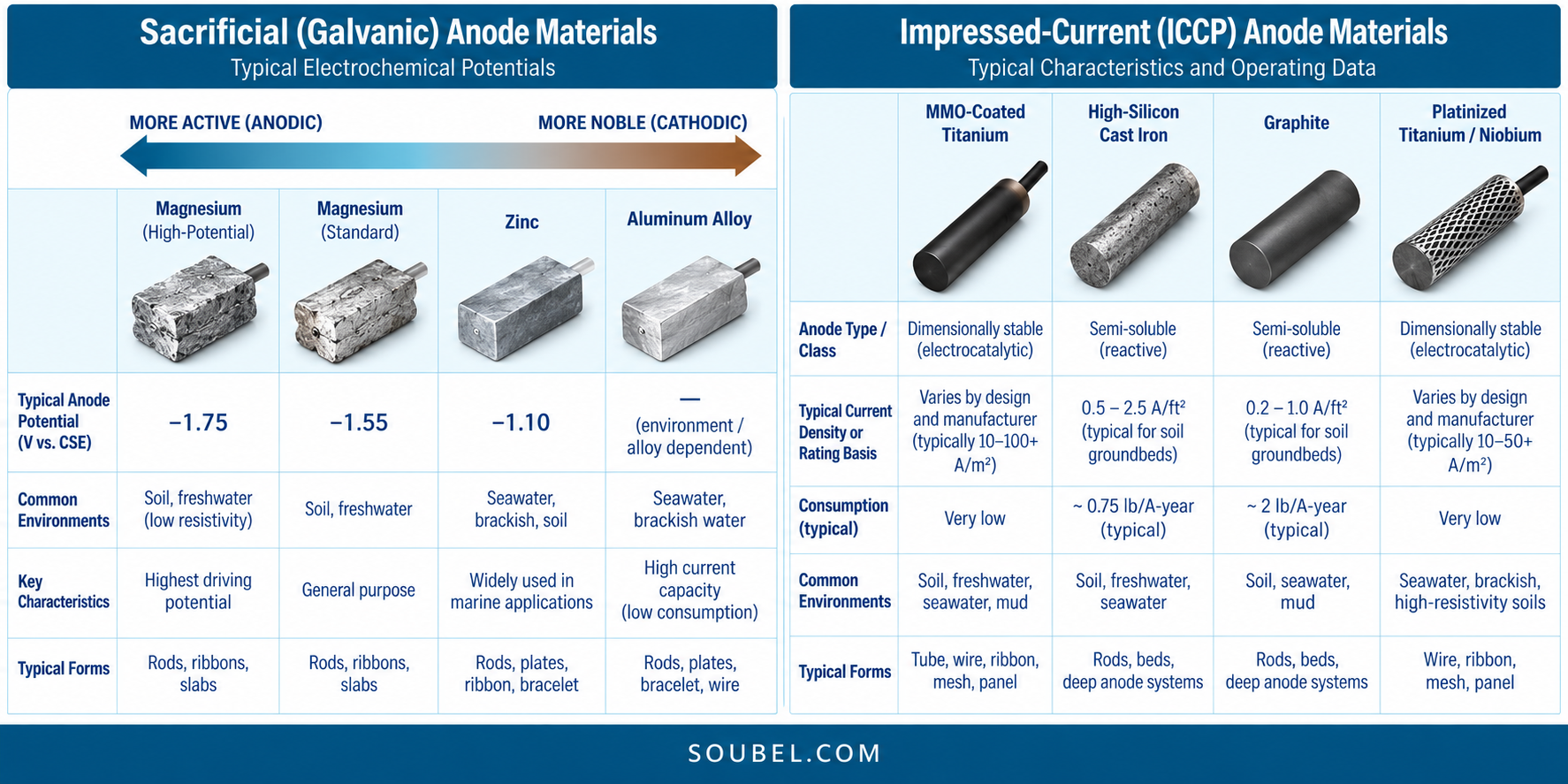
Technical Notes
Galvanic-anode potentials vary with alloy composition, electrolyte, temperature, surface condition, and operating conditions. Reference-electrode basis must be stated when comparing measured potentials.
ICCP systems use an external DC power source to drive current. ICCP anode materials are therefore compared by electrochemical performance, current-output capability, consumption, environment, configuration, and design life rather than by position on a galvanic nobility scale.
Mixed Metal Oxide (MMO) Anodes
MMO anodes typically consist of a titanium substrate coated with an electrocatalytic layer of mixed metal oxides. These coatings commonly incorporate iridium- and/or ruthenium-based oxides, with coating chemistry selected for the intended electrolyte and operating environment. The titanium provides the structural substrate, while the oxide coating provides the electrochemically active surface from which impressed current is discharged into the electrolyte.
Unlike galvanic anodes, MMO anodes do not provide the driving voltage for cathodic protection. An external DC power source supplies the driving force. This allows MMO anodes to operate at comparatively high current densities with very low anode consumption when properly selected and operated.
MMO-coated titanium is available in configurations including tubular, wire, ribbon, mesh, and discrete anodes. Applications include buried pipelines and groundbeds, tanks, marine structures, and other immersed systems. Coating chemistry and loading, anode configuration, electrolyte, operating current density, and required design life are important considerations in system design.