
If you spend enough time around industrial operations, you start noticing something:
Most assets don’t suddenly fail.
Their lifespan gets consumed quietly over time.
Not usually because someone made one terrible decision.
But because thousands of small operational decisions slowly add up.
“We’ll run it another quarter.”
“We’ll deal with it during the next turnaround.”
“It’s still operational.”
“We can’t justify replacement this year.”
And to be fair, most of those decisions make sense in the moment.
Teams are dealing with production pressure, shrinking budgets, staffing shortages, delayed parts, aging infrastructure, and nonstop operational demands.
But over time, those pressures start shaping asset life itself.
Equipment gets pushed harder.
Repairs become reactive.
Temporary fixes last longer than intended.
Older systems stay online because replacement costs are difficult to justify.
And sometimes the damage isn’t even visible.
Friends of mine in Louisiana who’ve worked around these environments their whole lives will tell you the same thing:
Assets age differently down on the Gulf Coast.
Heat.
Humidity.
Salt air.
Storm-related power fluctuations.
Aging infrastructure operating far beyond what it was originally designed for.
Even electrically, unstable power quietly stresses motors, drives, servers, instrumentation, and control systems long before obvious failure appears.
And in the pipeline and midstream world especially, integrity teams are still working hard to maintain PHMSA compliance, inspection schedules, repair criteria, and operational continuity at the same time.
But compliance does not eliminate operational pressure.
It simply defines the boundaries organizations must operate within.
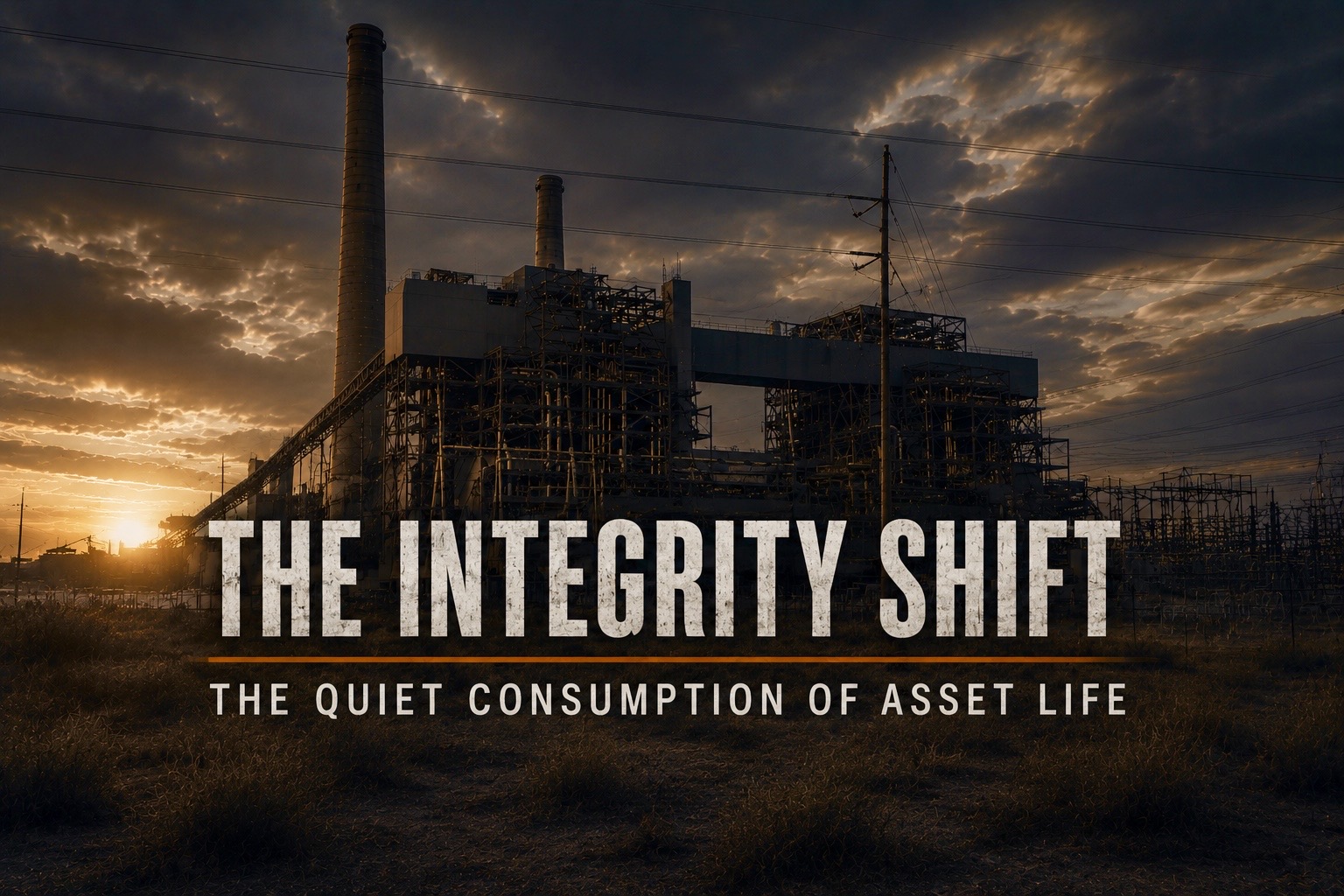
Years ago, I worked on a project at a coal-powered generation facility in Nevada. New regulations made it clear the company would never build another new coal facility again. Faced with that regulatory and political reality, the company was forced into a massive overhaul after years of deferred investment.
Facility engineers and maintenance teams know the reality:
Long-term reliability often loses the budget battle to immediate operational demand.
Maybe that’s the real Integrity Shift.
Not simply a shift in technology…
but a shift in how organizations balance operational continuity, reliability, risk, and long-term infrastructure health under increasing pressure.
So maybe the larger question becomes:
As industrial complexity continues accelerating… how do organizations preserve long-term operational integrity without quietly consuming the very assets they depend on?