Use the tool that can characterize the threat.
Tool technology, sizing capability, detection limits, inspection conditions, prior run history, validation results, and data quality determine what confidence can reasonably be placed in an ILI result.
PIPELINE & ASSET INTEGRITY
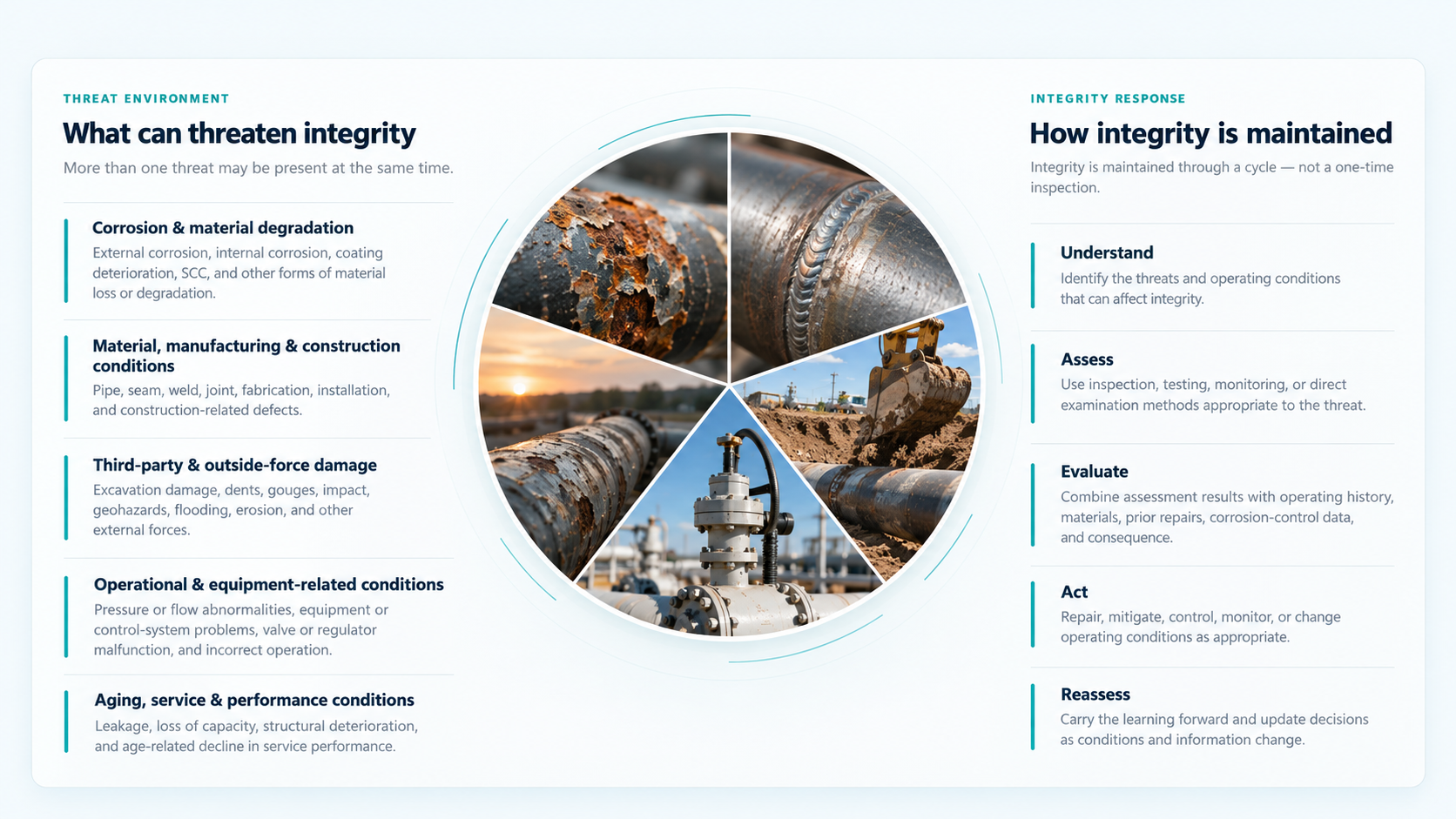
Pipeline integrity is a chain of decisions. The useful question is not only which assessment method was used, but whether the method fits the threat, whether the field evidence confirms the indication, and whether the resulting action and record improve the next decision.
01 · ASSESSMENT SELECTION
ILI, pressure testing, direct assessment, direct examination, NDE, and other methods answer different questions. The first discipline is matching the assessment method to the threat, the pipeline configuration, the information required, and the limitations of the method.
Tool technology, sizing capability, detection limits, inspection conditions, prior run history, validation results, and data quality determine what confidence can reasonably be placed in an ILI result.
Hydrostatic and other pressure-test approaches can demonstrate pressure resistance and expose certain defects, but they do not provide the same location-specific condition information as inspection or direct examination.
ECDA, ICDA, and SCCDA are structured processes that integrate pre-assessment, indirect evidence, targeted examination, and post-assessment learning for specific threats.
02 · DIRECT ASSESSMENT
ECDA, ICDA, and SCCDA all follow the same four-step shape — pre-assessment, indirect evidence, direct examination, post-assessment. That similarity is exactly what makes it easy to treat them as interchangeable. They’re not.
Each one exists because a different damage mechanism behaves differently, shows up in different places, and leaves different clues.
Same framework. Different physics. Use the wrong lens, and you can run a technically compliant assessment while still looking in the wrong place.
ECDA integrates pipeline history, corrosion-control information, coating and environmental context, complementary above-ground inspection methods, excavation findings, and post-assessment learning. Under 49 CFR 192.925, ECDA is a four-step process: pre-assessment, indirect inspection, direct examination, and post-assessment.
Decision focus: identify and prioritize indications, determine excavation urgency, compare indirect evidence with actual pipe and coating condition, and use the findings to improve reassessment and corrosion-control decisions.
Why CP matters here: CP performance, coating condition, interference, electrical continuity, and field measurement quality can materially affect the evidence used in an ECDA program.
ICDA uses pipeline-specific operating, elevation, flow, geometry, and other data to identify locations where liquid or electrolyte may reside and internal corrosion is most likely. For dry-gas ICDA under 49 CFR 192.927, the process includes pre-assessment, indirect inspection, detailed examination, and post-assessment monitoring.
Decision focus: determine whether ICDA is feasible, define ICDA regions, predict likely liquid-holdup locations, examine the pipe at the locations most likely to contain corrosion, and validate the model against what is actually found.
Important boundary: the federal dry-gas ICDA process is limited to normally dry natural-gas segments; the regulation contains additional requirements when electrolytes are normally present.
SCCDA systematically integrates data about pipe, coating, cathodic protection, environment, operating stress, temperature, cyclic loading, and other susceptibility factors, then uses indirect surveys and direct examination to test whether SCC is present.
Decision focus: identify susceptible segments, prioritize locations for examination, characterize discovered cracking, determine remediation, and establish reassessment based on the mechanism and conditions found.
Important boundary: SCCDA is complementary to other SCC assessment methods such as ILI or hydrostatic testing with a spike test; it is not automatically a substitute for them.
03 · FIELD VALIDATION
Integrity excavations and direct examination are where an assessment prediction meets the physical asset. NDE, coating observations, measurements, photographs, samples, metallurgical or laboratory work, and repair records can confirm, refine, or contradict what the assessment suggested.
The crew and technical team need to know what indication is being investigated, where it is expected, what measurements are required, and what evidence must be preserved.
Observed coating condition, corrosion morphology, crack characteristics, dimensions, NDE results, environmental observations, and photographs become part of the decision record.
The value of direct examination is not only the repair. The finding should feed back into tool performance, prioritization logic, threat models, future assessment, and the asset record.
04 · DATA, RISK & SOFTWARE
Assessment results, field findings, repairs, operating history, corrosion-control information, material properties, and prior decisions become more useful when they remain traceable over time. Integrity software can support that continuity; risk models and AI can extend analysis, but neither substitutes for reliable source data, context, validation, and qualified judgment.
Asset identity, location, date, method, tool or instrument, operating condition, units, assumptions, uncertainty, and disposition are what make a record useful later.
Useful systems connect history, inspection, field evidence, remediation, risk, and follow-up so the next reviewer can see what changed and why the prior decision was made.
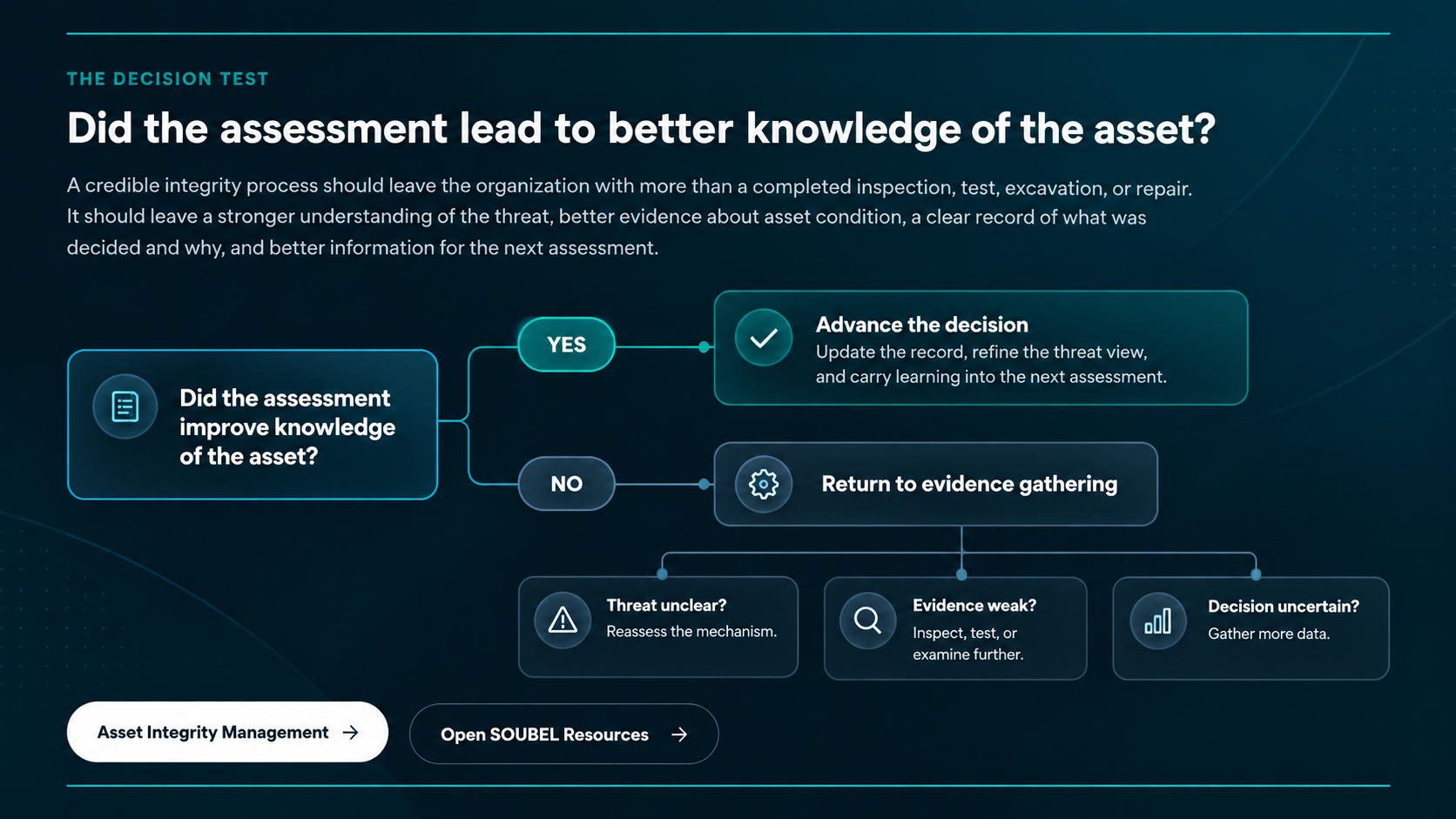
THE DECISION TEST
A credible integrity process should leave the organization with more than a completed inspection or excavation. It should leave a stronger understanding of the threat, a defensible action, and better evidence for the next assessment.